Search for what you want
Hot Search Terms
With the development of steam turbines in high-power power plants, the research on the protection methods against erosion damage of the last stage blades of steam turbines continues to receive extensive attention from personnel engaged in the power industry both at home and abroad. Severe erosion of the blades can not only cause blade fracture and damage, leading to serious accidents such as strong vibrations of the unit, but also reduce the efficiency of the stage. According to statistics, among 35 low-pressure cylinder blade damage accidents, 13 were mainly fracture accidents caused by erosion.
The development of long last stage blades is one of the key technologies for expanding the capacity of steam turbines. When developing long last stage blades, high requirements are placed on the aerodynamic performance, vibration characteristics, material properties, and machining process performance of the blades. At the same time, due to the increase in blade length, the protection against blade erosion occupies a very important position. The blades in the low-pressure part of the steam turbine operate in wet steam, and erosion occurs on the blades under the action of water droplets. Especially for the low-pressure last stage blades, due to the high steam humidity and high circumferential speed, the blades are extremely prone to erosion.
The water film from the surface of the stationary blade to the outlet edge is broken due to the action of the steam flow and forms water droplets with a diameter of tens or hundreds of micrometers. When these water droplets impact the surface of the moving blade, they change from a spherical shape to a film shape, so a high pressure is generated inside the contact part between the water droplets and the moving blade. The pressure exceeds the yield limit of the material, causing local plastic deformation and strain hardening of the blade material. Under the repeated action of this pressure, when the blade reaches the fatigue limit of the material, fatigue cracks begin to form. When water droplets impact the inside of these cracks, the pressure inside the water droplets will cause the cracks to develop deeper, resulting in the separation of the blade material from the blade surface and the formation of erosion.
The erosion rate of the moving blades (the amount of erosion per unit area per unit time) develops rapidly in the initial stage and then slows down significantly. Therefore, the erosion rate is not equal in different periods. (See Figure 1)
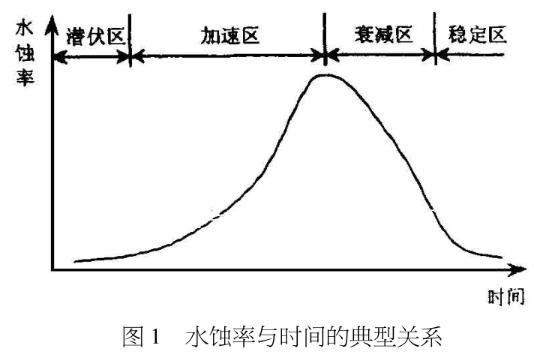
Figure 1 divides the erosion progress process into four regions, namely:
Latent zone: The weight of the blade material continuously decreases, and only local plastic deformation and strain hardening occur.
Acceleration zone: Due to the continuous accumulation of fatigue inside the material during the latent period, damage phenomena begin to appear, the blade material separates, and the amount of erosion increases sharply.
Attenuation zone: The erosion rate decreases rapidly, which is the deceleration stage of erosion.
Stable zone: The erosion rate almost remains a constant value and maintains a stable state.
As mentioned above, when erosion progresses to a certain extent, a water film will remain on the rough surface. Since the water film absorbs the impact pressure of the water droplets, it plays a buffering role, significantly reducing the erosion. In addition, even in the parts where there is no water film remaining, after the blade surface becomes rough, there is a tendency for water droplets to impact the inclined surface. The vertical component of the water droplet velocity acting on the inclined surface is significantly reduced, resulting in a significant decrease in the erosion rate.
Due to the continuous occurrence of erosion fracture accidents of steam turbine blades, it poses a certain threat to the safety of steam turbines. Since the 1970s, many countries have conducted large-scale experimental research to find solutions, including the formation and concentration mechanism of corrosive media on the metal surface, improving the water chemical conditions to ensure steam quality, improving the operation level of power plants and strengthening monitoring during operation, and finding stable materials to prevent blade erosion. However, blade erosion damage is a very complex fracture phenomenon involving various aspects such as chemistry, metallographic physics, and mechanics. There are more than 50 low-concentration harmful compounds in the steam as a corrosive medium, but the impact of different impurities on blade erosion is still unclear. The understanding of the formation and propagation process of blade erosion fractures is basically empirical. Therefore, a large amount of experimental research work still needs to be carried out in depth.

Media Attention